
Reports
Community-Led Monitoring of Health Services
Overview
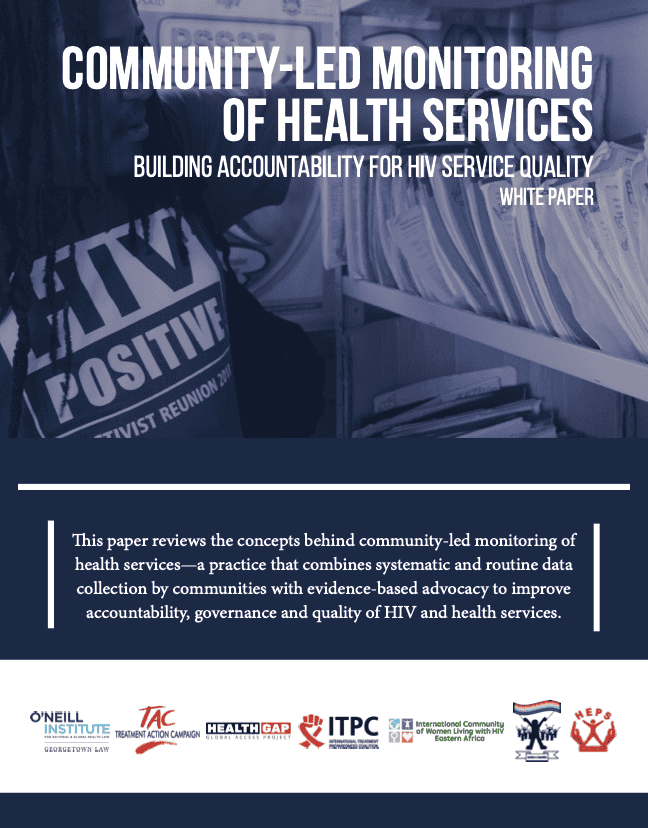
This paper explores the transformative potential of community-led monitoring (CLM) to address critical gaps in HIV service quality and accountability. Despite global progress, HIV outcomes remain uneven, with high “loss to follow-up” rates and systemic challenges like stock-outs, discrimination, and poor retention. CLM empowers affected communities to collect data, advocate for change, and hold decision-makers accountable—bridging the gap between service users and policymakers.
Key Insights:
- Accountability Deficit: Decision-makers often lack direct accountability to HIV service users, especially marginalized populations. CLM amplifies community voices to demand better services.
- Cycle of Impact: CLM combines data collection, analysis, advocacy, and monitoring to drive actionable solutions—from facility-level improvements to national policy shifts.
- Community Leadership: Success hinges on organized, resourced communities leading the process, ensuring solutions are locally relevant and politically viable.
- Urgent Need: With donor transitions and rising HIV rates among youth, CLM is a timely tool to improve retention and service quality.
Publication Year:
2020
Source | Publisher:
O'Neil Institute for National and Global Health Law
Best Suited For:
Monitoring & Evaluation Team, Programs Team
Latest:
Securing Non-Profit Funding: How 28 Leading Organisations Secured Funding to Increase Their Reach and Impact
A global research report analysing how 28 high-impact nonprofits have successfully secured funding to achieve impact at scale. Drawing on interviews and financial data across organisations operating in over 70 countries, the report explores funding…
Redefining Risk: The Cost of Not Funding Women’s Rights Organizations
This report challenges conventional notions of financial risk in development and philanthropy by shifting the focus from the perceived risks of funding women’s rights organizations to the far greater risks of not funding them. It…